New in PNAS: Uncovering the Embodied Dimension of the Wandering Mind
posted on April 7, 2026
We’re excited to share that our latest paper, “Uncovering the embodied dimension of the wandering mind”, is now published in Proceedings of the National Academy of Sciences (PNAS). Led by Leah Banellis and the rest of the ECG team, this study introduces the concept of body-wandering – the tendency for the wandering mind to turn toward sensations from the body itself.
Read the full paper: Banellis et al. (2026), PNAS
What is body-wandering?
When our minds drift, we typically think of daydreams about the past, future plans, or social scenarios. But our research shows that the wandering mind also frequently turns inward – toward the heartbeat, breathing, stomach sensations, and other signals from the body. We call this body-wandering, and it appears to be a robust and previously overlooked dimension of spontaneous thought.
As part of the Visceral Mind Project, we studied over 500 participants using resting-state fMRI combined with a new multidimensional experience sampling approach that included probes targeting interoceptive and somatomotor thoughts. This allowed us to map, for the first time, the phenomenological landscape of embodied mind-wandering at scale.
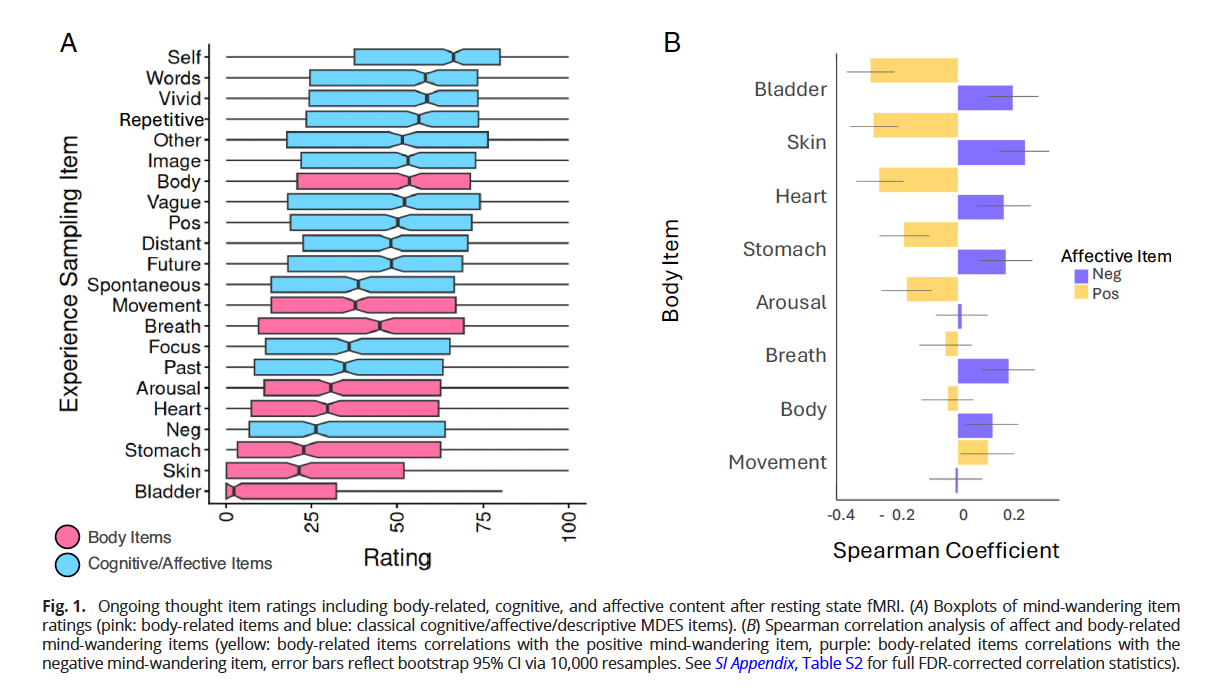 Figure 1. Ongoing thought ratings (A) and Spearman correlations between body-related items and affective content (B). Body-focused thoughts were consistently linked to heightened negative emotion.
Key findings
Our results reveal several striking patterns:
-
Body-wandering is real and common. Participants reliably reported thoughts about breathing, movement, heartbeat, and other bodily sensations during rest. Breathing was the most frequently reported interoceptive feature.
-
Body-wandering has a negative emotional tone. Unlike typical mind-wandering, which tends to be positive, thoughts about the body were consistently associated with heightened negative affect and reduced positive emotion.
-
Yet body-wandering is linked to better mental health. Paradoxically, individuals who reported more body-wandering showed lower self-reported symptoms of both ADHD and depression. This suggests that while body-focused thoughts may feel unpleasant in the moment, the capacity to notice bodily signals may be protective over the longer term.
-
Reduced body-wandering tracks with physiological hypoarousal. Participants with higher depression or ADHD scores showed reduced bodily activity across cardiac, respiratory, and gastric signals – potentially explaining why these individuals are less likely to body-wander.
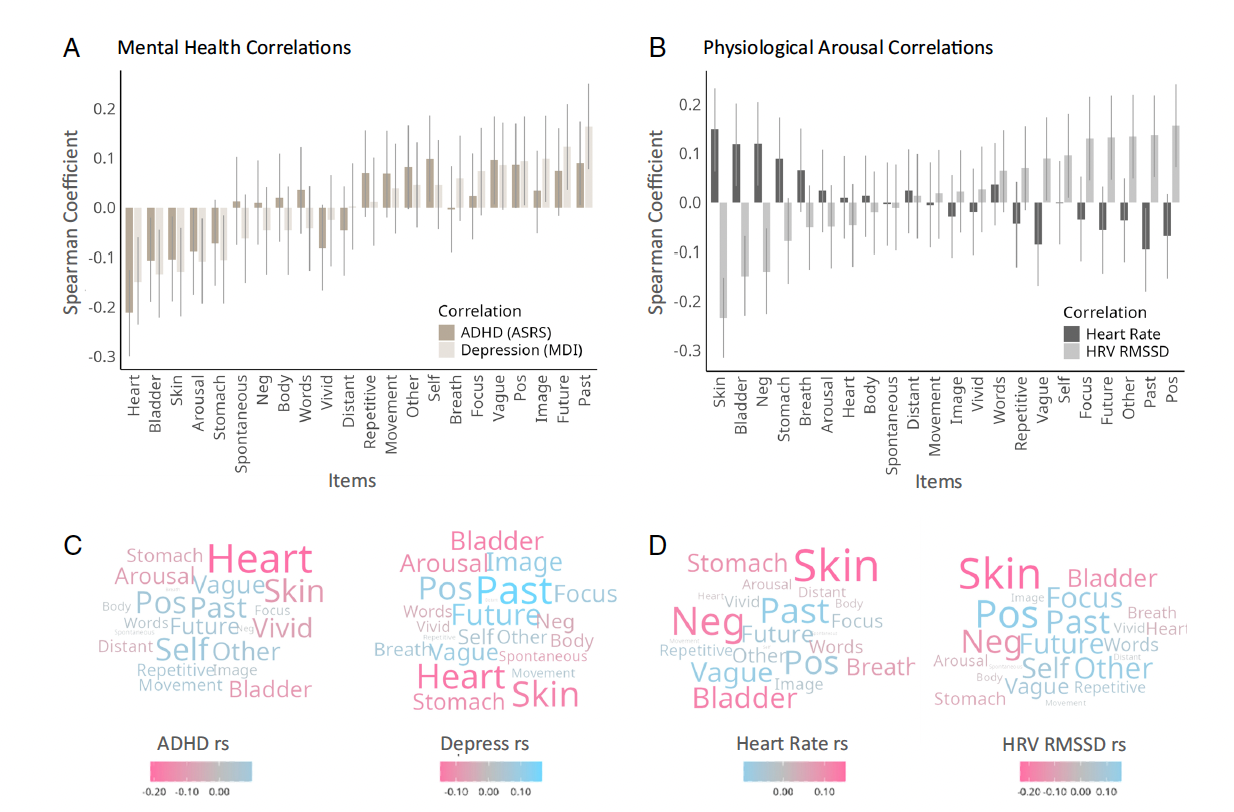 Figure 2. Correlations between mind-wandering dimensions and mental health (A) and physiological arousal (B), with word clouds showing the thought content profiles associated with ADHD, depression, heart rate, and heart rate variability (C, D).
A distinct neural signature
Using Canonical Correlation Analysis, we identified a significant brain-behaviour mode linking body-wandering to a distinct pattern of thalamocortical connectivity. This connectomic fingerprint interlocks somatomotor and interoceptive-allostatic cortical networks – circuitry involved in sensing and regulating the body’s internal state. This provides direct neural evidence that embodied thoughts are not merely subjective reports, but are reflected in the functional architecture of the brain.
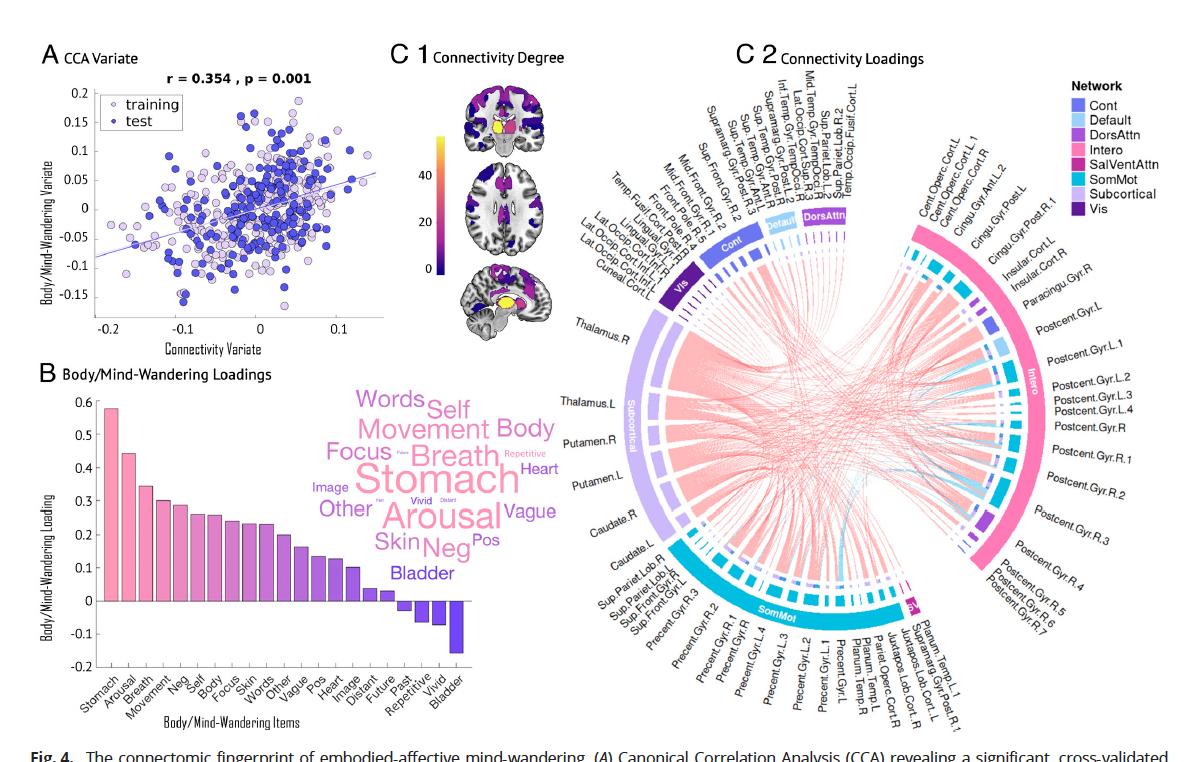 Figure 4. The connectomic fingerprint of embodied, affective mind-wandering. CCA revealed a significant cross-validated mode linking body-oriented thought patterns to thalamocortical-somatomotor connectivity.
Why it matters
These findings challenge the long-held assumption that mind-wandering is a purely cognitive, disembodied process. Instead, our work shows that the body is woven into the fabric of spontaneous thought – and that how much your mind turns toward the body during idle moments may reflect deeper patterns of emotional regulation and mental health.
As Leah Banellis writes in her essay for Psyche:
Take a moment to think about your own repeating patterns of thought. When your attention drifts, do you tend to mostly mind-wander into abstract thought? Or do you also body-wander? Do you notice your breath, your heartbeat, or your stomach? Our findings suggest that your answer to these questions might reflect your deeper emotional and attentional tendencies.
In the press
The paper has received wide coverage, and we’re grateful to the journalists who helped communicate these findings to a broader audience:
- Science News: When our minds wander to the body, it may affect mental health – Diana Kwon covers the key findings and their implications for understanding depression and ADHD.
- Psyche: How much you ‘body-wander’ could affect your mental health – a first-person essay by Leah Banellis exploring the science and its personal relevance.
- Grow Kudos: Plain-language summary
Enthusiastic reception on social media
We’ve been thrilled by the positive and enthusiastic reception from the scientific community and public alike. The findings sparked lively discussion across platforms:
Thank you to everyone who shared, commented, and engaged with the work. It’s been wonderful to see so many people reflecting on their own experiences of body-wandering.
The team
This work was a true team effort. Congratulations to all co-authors: Leah Banellis, Niia Nikolova, Malthe Braendholdt, Melina Vejloe, Ignacio Rebollo, Nicolas Legrand, Francesca Fardo, Jonathan Smallwood, and Micah Allen. The paper is dedicated to the memory of Jonathan Smallwood, whose pioneering work on mind-wandering laid the foundation for this research.
Citation
Banellis, L., Nikolova, N., Braendholdt, M., Vejloe, M., Rebollo, I., Legrand, N., Fardo, F., Smallwood, J., & Allen, M. G. (2026). Uncovering the embodied dimension of the wandering mind. Proceedings of the National Academy of Sciences, 123(14). https://doi.org/10.1073/pnas.2520822123
Comments
Comments are threads in this site's GitHub Discussions. Posting requires a GitHub account.